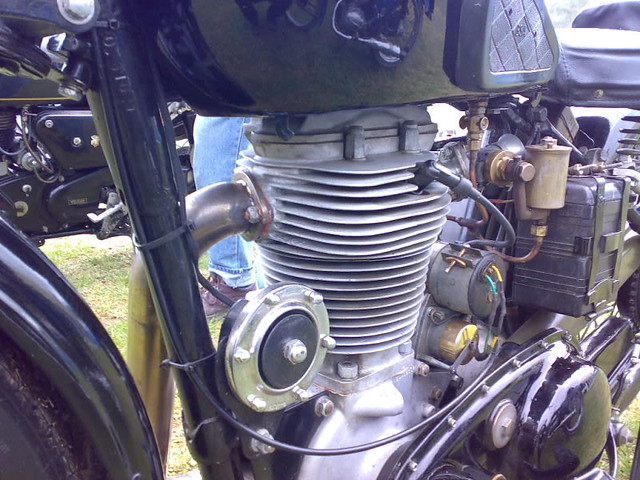
Moto Technica Velox,who were located in Turin,are well known for the OHV conversion kits for the M20 and 16H,they also made conversion kits for the 3HW,G3L,WNG,and WD/CO,the kits were heads and barrels made out of light alloy.A Gruppo-Velox converted Triumph 3HW took part in the 1951 1,400 kilometre Milan - Taranto road race,at the time the worlds longest road race on public roads.  Picture above is of the 3HW cylinder head.
Strange that they went back to hair springs for the valves? Ron
email (option): ronpier@talk21.com
Poor design this, one spring for both valves, if the spring breaks both valves hit the piston!
It looks like one spring but it isn't...There's two for each valve in fact. One end of each spring fits into the valve collar of both valves and the wound element fits over a centrally mounted spindle...
Hairpin valve springs were in common use at the time and for many years afterwards, so they weren't really 'going back' to anything, it was just the choice they made...Ian
email (option): ian@wright52.plus.com
Ian, Yes, I should have looked at the drawing more carefuly, in fact it is a very clever design, fitting four springs into a compact space.
An easy enough mistake...I have some first hand knowledge of the Gruppo Velox as I rebuilt one for a friend...
There are in fact only two springs...The end of one spring fits under the valve collar of the exhaust valve, then it is wound into a coil and the other end fits under the collar of the inlet valve...
A second 'mirror image' spring is fitted the same way but on the opposite side of the valves and has its ends fitted under the opposite sides of the valve collars....Ian
email (option): ian@wright52.plus.com
Here is the Gruppo-Velox conversion kit fitted to a Triumph 3HW bottom half.  Below is the M20 and 16H ohv conversions.
  Below is the cover of a brochure.
Here's another Italian conversion:

Jan
email (option): wd.register@gmail.com
And a bizarre French job:


Jan
email (option): wd.register@gmail.com
 Below is the M20 and 16H ohv conversions.
  Below is the cover of a brochure.
Great catalog pics.
I note from the drawing of the BSA Gruppo Velox that the carb is located in roughly the same position and orientation as the original with a curved manifold which obviously would have been supplied in the kit from Gruppo Velox. Unlike these two set ups with the carb mounted horizontally, which when I took the photo of this bike, (it's not mine) seemed like the only place for the carb to go.
https://www.youtube.com/watch?v=czpok3l1cRw
I would like to fit one of these conversions to my post war M21. Hint, hint! Anyone have one for sale?
There are a number of drawbacks with this kit..Firstly, as the M20 bottom end is retained in its entirety, the long and flexible M20 con rod is used. That would be a serious weak point if the engine was used in a high state of tune.
Also, the overly heavy M20 flywheels are retained...So, there's no chance of it revving out whatever cams etc. are fitted.
Secondly, to keep the overall height of the engine within a range that will fit into an M20 frame, yet providing enough space for the OHV cylinder head, the piston has to have very little material above the gudgeon pin...So, a very non standard piston is employed with two rings below the gudgeon pin...(and a pretty low compression ratio)
This could be addressed if the bottom end was being rebuilt as the M20 rod could be changed for a 'long' B31 rod thus providing the space for a more conventional piston...The M20 flywheels could also be lightened at the same time.
The third problem is that the kit appears to have been made to fit more than one engine type and as a consequence when fitted to an M20 the cam followers do not line up with the rocker arms in the ideal way. In other words, the cam followers are more 'outboard' of the centreline of the engine than the rocker arm ends....
That means the pushrods are operating at an angle to the cam followers, not an ideal situation for higher revs. This could be improved by having ball ended pushrods and cup type tappet heads....However, the basic misalignment would remain and may limit the engines rev range...On the plus side the valve and port sizes are well suited to improved performance...
In its standard form I would say that although the engine may look like a Gold Sar I think it would struggle to match the performance of a B33...Ian
email (option): ian@wright52.plus.com
Not a Gruppo-Velox 3hw engine conversion,but a 3HW post war Italian frame and cycle part conversion. 